Club history
Founded as the Emu Cricket Club on 13 October 1859 at the Miners Arms Hotel in Rowdy Flat, Yackandandah cricket has folded, revived and re-formed a dozen times across more than 160 years. This is the record of the seasons and the grounds.
Early years and ground shifts
Founded as the Emu Cricket Club on Oct 13, 1859, at the Miners Arms Hotel in Rowdy Flat. Later operated as the Yackandandah Cricket Club.
Merged with Clear Creek Club (Dec 1861). Played in inter-regional trial matches; club players featured in an Ovens team against England at Beechworth in Jan 1862.
Moved home grounds from Rowdy Flat to the local Golf Course site (reserved for racecourse and public recreation). Crosthwaite and Weston distinguished themselves against the All England Eleven in May 1864.
Played regular challenge fixtures against traditional rivals Beechworth, Chiltern, and Albury.
Re-emerged briefly from an economic slump before entering a hiatus until late 1876.
Challenge Cup and league changes
Introduced an innovative coir matting pitch designed by club secretary Richard Vickars-Foote and his brother.
Competed for the District Challenge Cup against Beechworth and neighboring clubs. Club paused operations from 1885 to 1888.
Formed the Yackandandah District Cricket Association (YDCA).
Reconstituted in Aug 1892; entered the Craven Trophy (Benambra) Cricket Association.
Re-joined the Beechworth Cricket Association; won the McGlenchy Trophy in 1897/98. Folded briefly after 1898/99 due to debt and lack of player numbers.
Competed across local competitions (Kiewa Valley, Falck, Bowden, Rea, Clune-Thompson, and YDCA). Operations ceased during World War I.
Interwar era and the move to Butson Park
Re-formed in Oct 1920 with new matting pitches laid at the Racecourse and Windham Street, followed by a concrete pitch in 1923/24. Ceased operation after 1924/25.
Land behind the Anglican Church was gazetted as Butson Park (Oct 12, 1929). Re-formed as The Yackandandah Footballers Cricket Club in late 1930.
Laid a concrete pitch at Yackandandah State School (1934). Won the 1939/40 Beechworth & District Cricket Association Premiership.
Played a match against the 1st Australian Imperial Force before district cricket was suspended until 1948 due to World War II.
Post-war expansion and the modern era
Re-formed in Aug 1948, laying a concrete pitch at Butson Park. Won the 1949/50 Beechworth & Kiewa District Premiership.
Renamed back to Yackandandah Cricket Club in 1954. Folded in 1957, revived in 1962, and briefly operated as a social club in 1966.
Re-launched as the Kangaroos in the Ovens and King Cricket Association. Junior cricket program launched with 56 local players.
Transitioned between the Wodonga Cricket Association and Ovens & Kiewa Valleys Cricket Association. Won the A Grade and B Grade White premierships in 1981/82.
Officially opened the new Yackandandah Sports Park oval and pavilion on Oct 2, 1983.
Re-affiliated with Wodonga & District Cricket Association. Highlights include B Grade premierships in 1992/93 and 2005/06, laying a turf wicket at the Sports Park (2001), and consecutive U14 premierships (1997/98, 1998/99).
Cricket Albury-Wodonga era
Joined the newly merged Cricket Albury-Wodonga (CAW) competition. Completed a sweep winning A, B, and C Grade District premierships in 2006/07, followed by an A Grade repeat in 2007/08.
Promoted to the CAW Provincial Division. Celebrated 150 years of history in 2009/10 alongside an Under 17 premiership.
Returned to District level, winning A Grade premierships in 2010/11 and 2018/19, and C Grade in 2017/18.
Navigated COVID-19 safety restrictions to secure three consecutive double-premierships in both A and B Grade (2020/21, 2021/22, and 2022/23).
Continued B Grade dominance with back-to-back premiership wins in 2024/25 and 2025/26.
Four grounds in 160 years
From a paddock opposite the Rowdy Flat settlement to the pavilion at Yackandandah Sports Park, the club’s home has moved with the town.
Rowdy Flat ground
Home for Yackandandah cricketers was initially Rowdy Flat, their first cricket ground almost certainly being located on the western side of Yackandandah Creek, roughly opposite the Rowdy Flat settlement. If it was there today the wicket would be accessed from Racecourse Road via Wildon Avenue.
There they played during the first three years on an oval circled by a racecourse with its grandstand set against the hill, until the present Yackandandah golf course site was reserved in 1863 for horse racing and public recreation and became the second home to Yackandandah cricket.
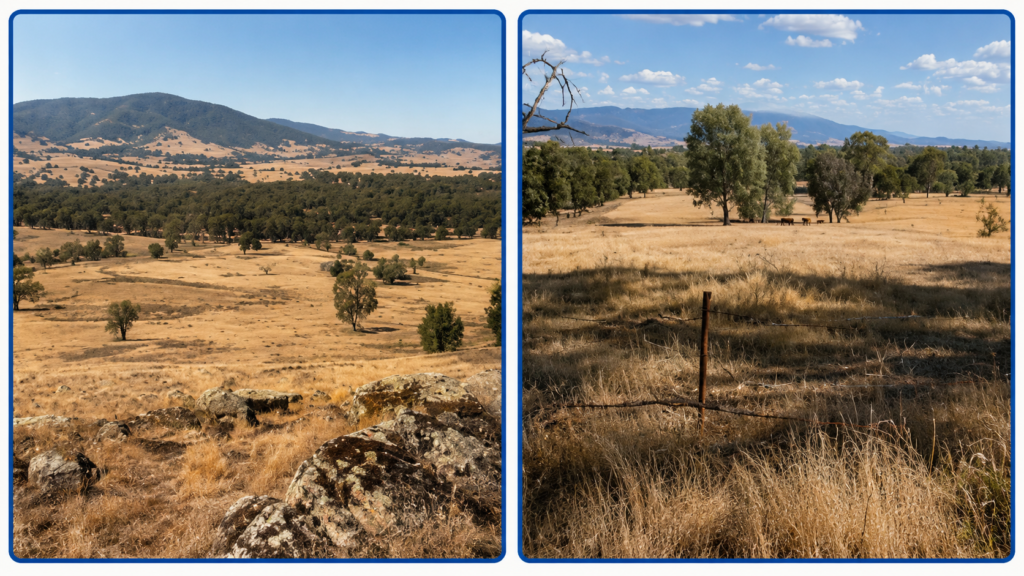
The country at Rowdy Flat, west of Yackandandah Creek, where the club played its first three seasons from 1859.
Racecourse and Public Recreation Reserve
As the 1863-64 season arrived, Yackandandah began unenthusiastically and re-formed late. Perhaps the loss of the old ground at Rowdy Flat was a factor. Then, as attention turned to clearing and fencing the new ground, and a second All England Eleven tour including the incomparable W. G. Grace became eagerly anticipated, club momentum returned, during that May 1864 tour.
Aiming to stimulate cricketing interest, the club in October 1922 laid a new pitch alongside the existing coir pitch at the Racecourse, and with player convenience in mind a second practice pitch was laid at the rear of Windham Street.
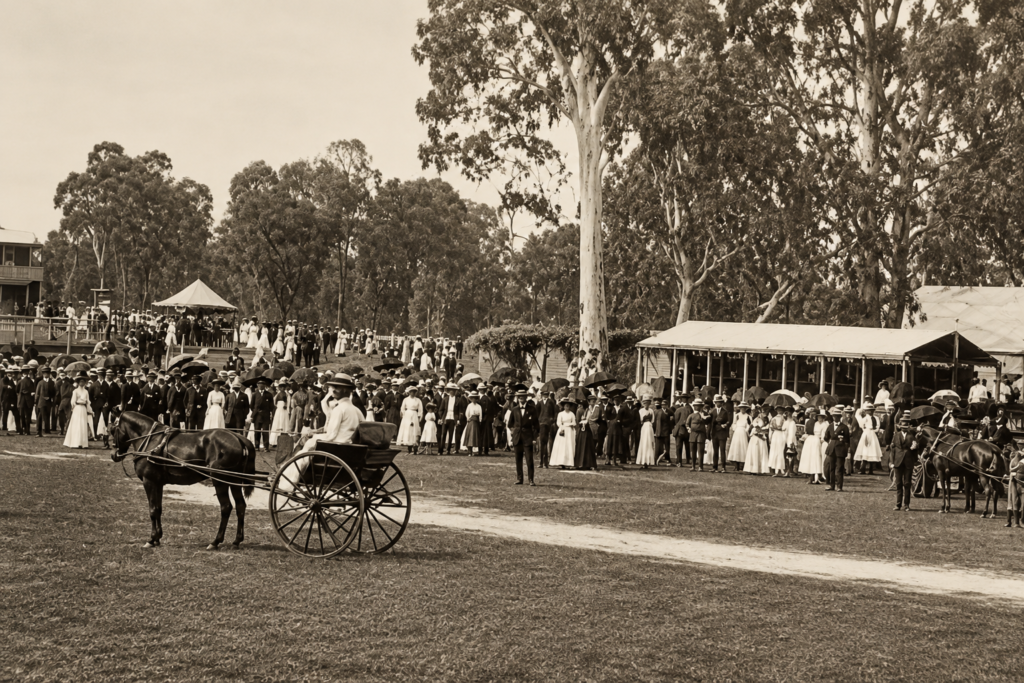
A gathering at the Racecourse and Public Recreation Reserve, the club’s second home from 1863.
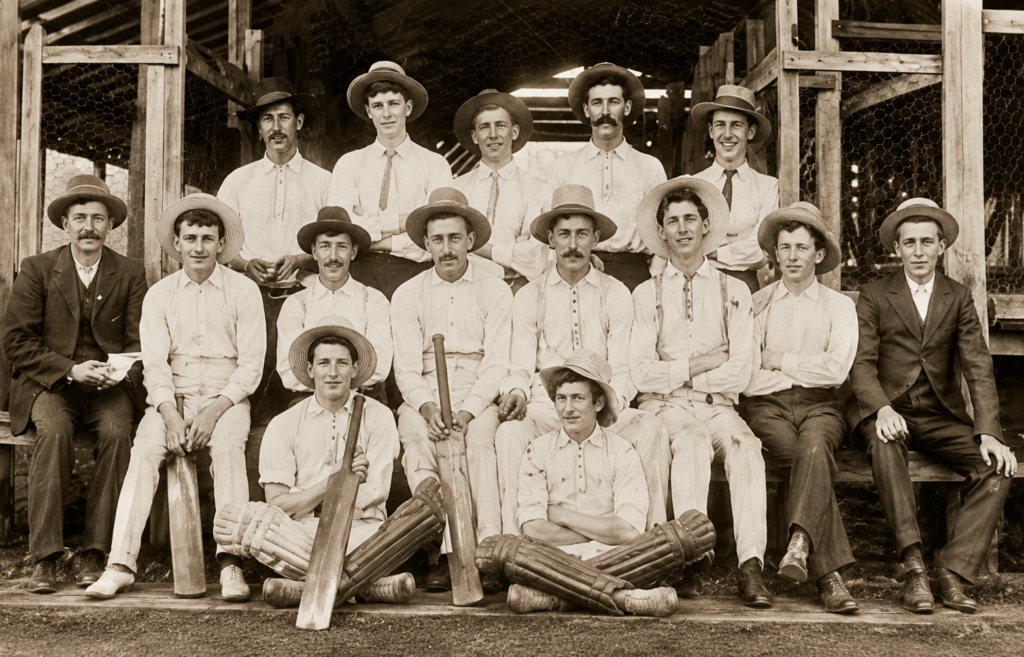
Yackandandah cricketers at the Racecourse and Public Recreation Reserve, undated, although several of these were players of the 1890s. Their names are: (Rear, L-R) B. Goodger, A. McCullough, J. McCullough, J. Connell; (Centre) E. Butson (scorer), W. Dunstan, M. Skewes, W. Montfort, R. McCullough, J. McIntyre, W. Graham, T. Nicholson; (Front) D. Hobbs, B. Taylor. (Source: Irene Pettiford)
Butson Park
Thoughts of a new cricket ground had begun to emerge. In March 1919 councillors met to consider the question of forming a public park on the land known as ‘Wallace’s’, by the creek behind the Anglican Church, an area known today as Butson Park.
By 1938 ambitious multi-purpose plans were in mind for the new recreation area, but the Second World War postponed further action. In 1940 it was decided that cricket and football would be played on the reserve extension after much rehabilitation, leaving the old section for golf and racing. In January 1950 the additional land became a separate reserve, courtesy of the Lands Department, and a meeting later that month appointed separate committees of management for the Yackandandah Racecourse and Recreation Reserve and for the Yackandandah Public Park and Recreation Reserve, which would be known as Butson Park — a name chosen in August 1949.
A meeting was held on August 4th 1948 and the Yackandandah Footballers Cricket Club was re-formed. Local chemist Max Lincoln was the driving force behind this resuscitation. A concrete pitch was laid at Butson Park, on their new football oval, just prior to the 1948 season commencing. The Cricket Club still shares the Butson Park oval with the Yackandandah Football Club to this day.
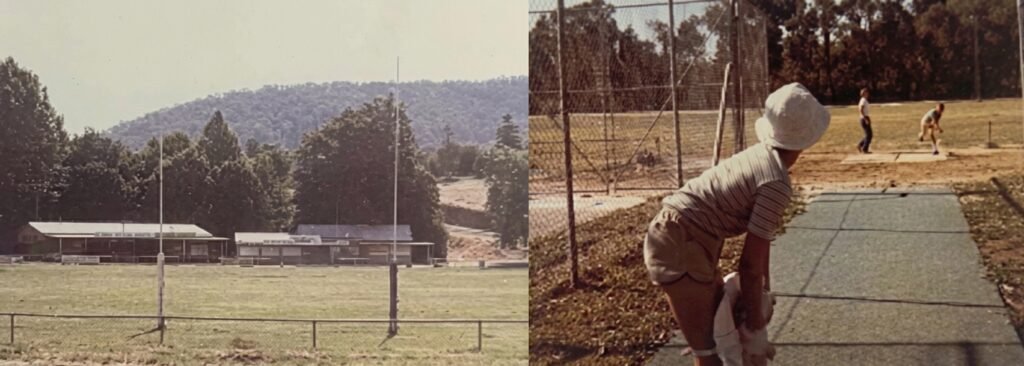
Left: the Butson Park pavilion and oval, shared with the Yackandandah Football Club to this day. Right: juniors having a hit at Butson nets, January 9 1983 — Rob Engwerda batting, Mick Barnard bowling. (Source: Col Barnard)
Yackandandah Sports Park
In late August 1981, the Yackandandah Cricket Club committee — led by President Ian Thomas and Secretary Neil Bradford — announced plans to secure a new home ground at the nearby Sports Park site.
Late 1981–1982: Yackandandah Shire Council contracted to buy the land, establishing the location as the township’s primary recreation hub.
1983: Earthworks began in January, with the oval completed and sown by late April. Tennis courts and a brick clubhouse were constructed, and space was allocated to the Horsemen’s Association.
September–October 1983: Backed by an interest-free $5,000 loan, the cricket club laid its new pitch on September 25. The Sports Park officially opened on October 2, followed by the first senior match six days later. To assist with costs, the Victorian Country Cricket League awarded the club a record $1,250 grant.
1986: Scouts erected a steel storage shed, while the Cricket Club added paving, logs, and gardens for parking control.
1987–1989: A $3,000 loan funded pitch resurfacing at both Butson and Sports Parks in March 1987. In May 1989, the club incorporated its junior and senior arms and transferred from the Ovens and Kiewa league to the Wodonga and District Cricket Association.
1992–1995: Council budgeted $250,000 for a new stadium in 1992. Volunteers collected materials from a disassembled building in Orange, contributing hundreds of labour hours to complete shared clubrooms and facilities by 1995.
2009–2010: Backed by $1.2 million in government grants, stadium completion resumed in late 2009 alongside a third practice pitch. The multi-purpose stadium facilities officially opened on August 25, 2010, and is known today as the Nelson McIntosh Pavilion.
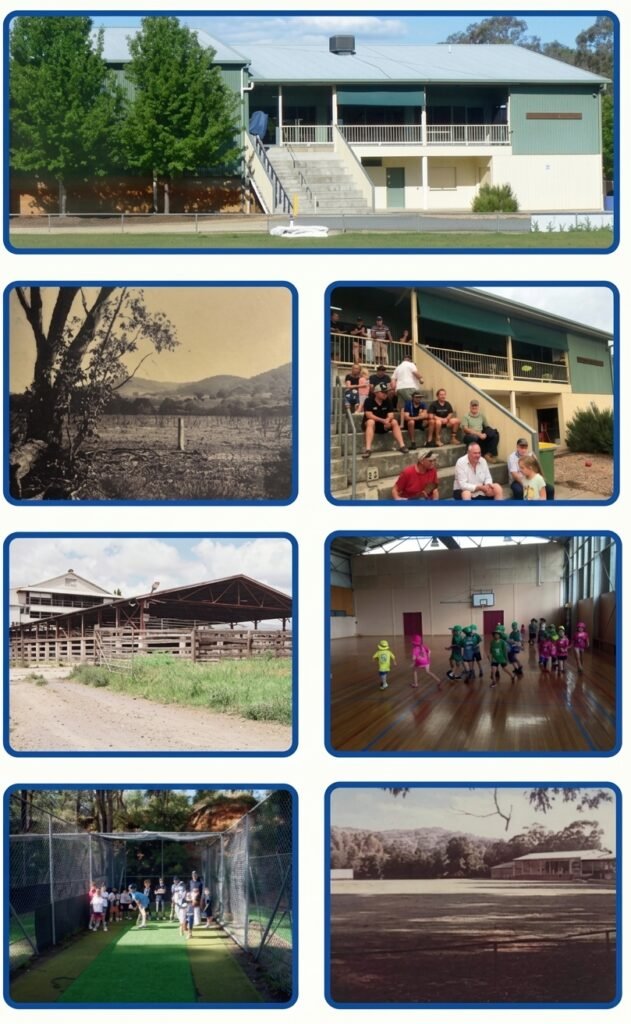
Yackandandah Sports Park today: the Nelson McIntosh Pavilion, the oval, the nets and the indoor stadium.
Add your season to the record
Sixteen decades, four grounds and more premierships than most clubs in the district. Registrations open each September.

© 2026 Yackandandah Cricket Club